
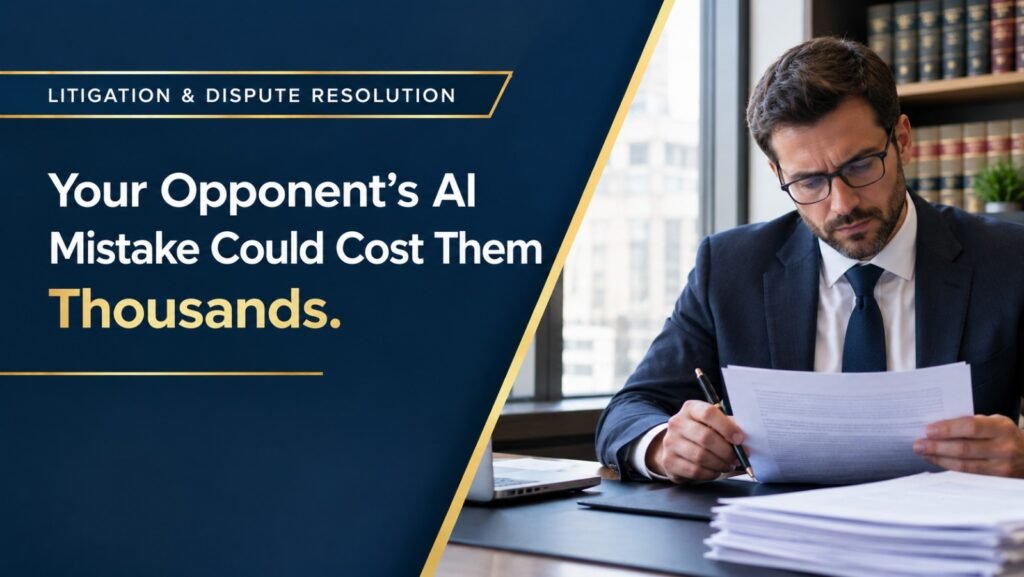
Your Opponent's AI Mistake Could Cost Them Thousands. Your Own Firm's AI Mistake Could Cost You a Referral to the SRA.
Someone considering legal action rarely goes straight to a solicitor any more. They ask a chatbot first, whether they have a case, what it might be worth, and what the other side is likely to argue. They arrive at your firm holding a strategy formed by a tool that has never seen a witness statement, never weighed evidential sufficiency, and has no real sense of litigation risk or proportionality.
Some of what they believe will be reasonable. Some of it will set unrealistic expectations about timescales, costs, or outcome, expectations you will spend real time in that first meeting correcting.
The Cost When It Goes Wrong in Court
This is where litigation carries a risk other practice areas do not face in quite the same way, the mistake happens in open court, in front of a judge, with a paper trail.
UK courts have already issued wasted costs orders after fictitious case citations were relied upon, ordering the parties responsible to pay the other side’s costs personally, and referring them to their regulators. The mechanism is straightforward: a fabricated citation does not just embarrass a lawyer, it produces a costs order with the client’s opponent’s name on it, and a regulatory referral that follows the individual, not just the case.
The Regulator's Position Is Now Explicit

The SRA’s warning notice, issued in August 2026 after 42 reports of AI misuse in twelve months, states plainly that solicitors remain fully accountable for AI-generated content and may face disciplinary action if they fail to verify its accuracy, regardless of whether AI was used. Using AI does not transfer or dilute professional responsibility, and the SRA’s own reporting shows this failure pattern already reaching the courtroom more than once.
The Civil Justice Council has gone further, publishing an interim report and consultation in February 2026 specifically on the use of AI in preparing court documents, a sign that formal procedural rules on AI disclosure in litigation may follow.
Litigants in Person Bring a Different Risk
Litigation also has a distinct feature other practice areas encounter less often, a growing number of litigants in person using AI to draft their own claims, defences, and witness statements. Courts and tribunals have shown some latitude toward self-represented parties, but have been clear that no one is immune from sanction for a serious breach of the rules, including submitting fabricated authorities. For your firm, that means opposing a self-represented party today carries a real chance of encountering AI-generated material on the other side that needs to be checked and challenged properly, not assumed to be reliable simply because it looks confident and well cited.
The Proof This Is Not Hypothetical
This is not a fringe view. On The Diary Of A CEO, entrepreneur Daniel Priestley told Steven Bartlett about a legal case that would have cost him fifty thousand pounds to open with a law firm. He resolved it instead using an AI tool for roughly twenty dollars a month, working through decision pathways, the documents he needed, and exactly what to say in the negotiation. His view on where this leaves the profession is direct. The lawyer of the future becomes part business coach, part prompt engineer, guiding a client’s own AI use rather than doing all the work themselves. Watch: “Daniel Priestley: AI Will Make Plumbers Earn More Than Lawyers! (2029 Prediction)”.
Watch: Daniel Priestley: AI Will Make Plumbers Earn More Than Lawyers! (2029 Prediction)
Where AI Fits, and Where It Stops
AI genuinely helps with the volume side of litigation, document review, disclosure exercises, and drafting first drafts of routine correspondence. What it cannot do, and what current guidance is consistent on, is replace the professional judgement needed to assess litigation strategy, evidential sufficiency, or proportionality. Every citation an AI tool produces needs the same verification a junior lawyer’s work would receive, not less scrutiny because it came out fluent and confident.
The same discipline applies to client-facing communication. An AI agent handling enquiries or client updates never assesses the merits of a case or predicts an outcome. Its role is to be the gatekeeper, keeping clients informed and reassured between the moments that genuinely need a lawyer’s judgement.

"But We've Already Had a Bad Experience With This"
If your firm has already had a fee earner rely on an AI-drafted argument that turned out to contain an error, that is precisely the risk a proper verification process is built to catch, not a reason to ban AI outright and lose the genuine efficiency gains available in disclosure and document review.
If the concern is confidentiality, particularly given how much sensitive material moves through litigation files, that is exactly right, and it is the first thing addressed in how any of this gets built for your firm.
Why This Matters More in Litigation Specifically
Litigation is the practice area where an AI mistake is least likely to stay quiet. It happens in front of a judge, becomes part of the court record, and can trigger a wasted costs order and a regulatory referral, consequences with your name attached rather than a private client conversation. A firm with a properly supervised AI process, understood and followed by every fee earner, is protecting itself as much as it is serving clients faster.
What Working Together Actually Looks Like
This starts with understanding how your firm currently uses AI in drafting and disclosure, what verification process exists before anything reaches a court, and how confident your team feels checking AI-generated citations under deadline pressure.
From there, the work is either a tailored one-to-one consultation for your firm, or a full training day covering safe AI use, verification discipline, and client communication. Nothing generic, nothing off the shelf.
The firms getting hurt by AI in litigation are not the ones avoiding it. They are the ones using it without a proper verification process. The only real decision left is whether your firm has that process in place before the mistake happens, or after.