
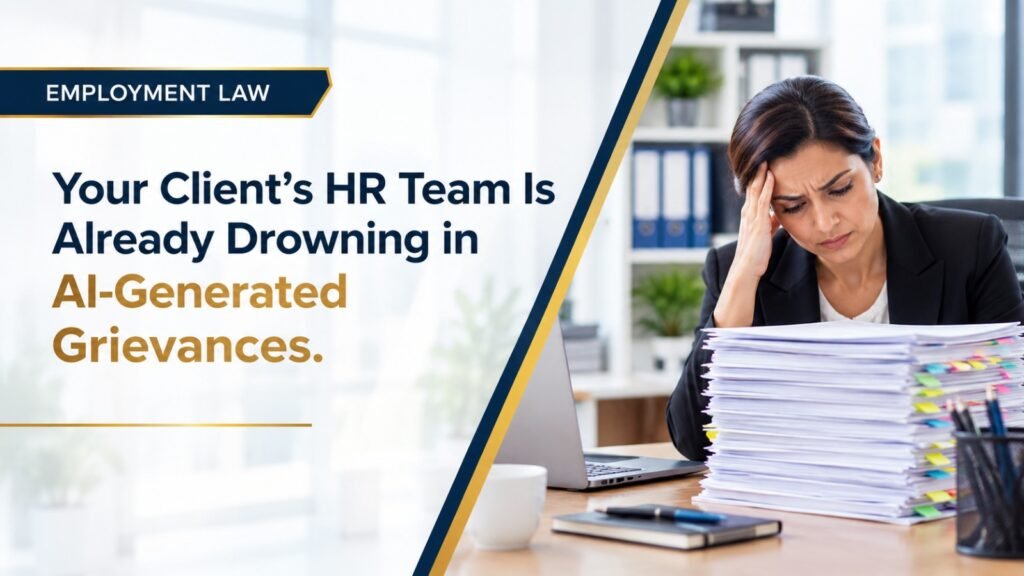
Your Client's HR Team Is Already Drowning in AI-Generated Grievances. Are You Ready to Help Them Through It, or Still Reading Every Page by Hand?
A grievance used to be a paragraph. A disagreement with a manager, a complaint about workload, something an HR team could read in five minutes and act on the same day.
Now it arrives as a fifty-page document, generated by ChatGPT, packed with legal terminology, references to discrimination, victimisation and breach of trust and confidence, whether or not any of that actually applies. It looks like a strong case. Reading it properly to find out whether it is one takes days, not minutes.
This is not a rare event any more. Ninety-five percent of HR directors report they have dealt with an employee using AI to raise a grievance or navigate a dispute in the last year, and in seventy-eight percent of those cases the document relied on information that was inaccurate or misrepresented. Seventy percent of UK employers say they have seen a clear rise in AI-assisted grievances.
The Number That Should Worry Your Client
The Employment Tribunal system is already under pressure before any of this. Open single tribunal cases rose from roughly forty-five thousand in March 2025 to sixty-four thousand in March 2026, a forty-two percent increase in a single year, according to Law Society reporting.
Every one of those cases now takes longer to process than it used to, because the fifty-page AI-generated grievance and the fifty-page AI-generated ET1 both need the same careful, human read before anyone can work out what is actually being argued. A firm still reading these by hand, page by page, is going to lose ground to one that can triage the same document in minutes with an AI agent, flag what is real, what is padding, and what is simply wrong.
Where This Already Went Wrong

This is not theoretical. In August 2026, the SRA issued a formal warning notice after receiving 42 reports of AI misuse in twelve months, covering false material reaching courts and tribunals, and confidential client information going into tools that were never built to protect it. The pattern it describes, fabricated content reaching a tribunal because nobody checked it properly, applies directly to a grievance or ET1 riddled with AI-invented material.
The confidentiality risk is just as real. UK tribunals have already confirmed that pasting confidential material into a public AI tool can amount to publishing that information, breaching confidentiality and risking a waiver of legal privilege. That principle applies just as directly to an HR manager checking a grievance response through an AI tool as it does to any solicitor doing the same with a client file.
The Law Society’s own guidance on generative AI sets out the same message from the other side, for firms trying to get this right rather than get caught out.
The Wider Point, Backed by Someone Outside the Profession
On The Diary Of A CEO, entrepreneur Daniel Priestley told Steven Bartlett about a legal case that would have cost him fifty thousand pounds to open with a law firm. He resolved it instead using an AI tool for roughly twenty dollars a month, working through decision pathways, the documents he needed, and exactly what to say in the negotiation. His view on where this leaves the profession is direct. The lawyer of the future becomes part business coach, part prompt engineer, guiding a client’s own AI use rather than doing all the work themselves. Watch: “Daniel Priestley: AI Will Make Plumbers Earn More Than Lawyers! (2029 Prediction)”.
Watch: Daniel Priestley: AI Will Make Plumbers Earn More Than Lawyers! (2029 Prediction)
Where AI Fits, and Where It Stops
To be clear about what this is and is not. An AI agent triaging grievances or handling first-contact enquiries never gives legal advice, never decides whether a claim has merit, and never replaces the judgement of a solicitor or HR professional. Its job is to do the first read: summarise what has actually been alleged, flag what looks inaccurate or unsupported, and surface the real issue underneath the legal language, so the humans making decisions can do it in minutes instead of days.
The same logic applies to your own team. Fee earners who know how to use AI properly to triage and summarise, rather than reading fifty pages cold every time, can handle a rising tribunal caseload without a rising headcount.

"But We've Already Had a Bad Experience With This"
If your firm has already seen an AI-generated grievance or claim waste days of a fee earner’s time, that is exactly the problem this solves, not a reason to avoid AI altogether. The tool causing the problem, an employee generating fifty pages of padding in minutes, is the same category of tool that can cut through that padding in minutes too, used properly and on your side of the desk.
If confidentiality is the concern, that is the right instinct, and it is the first thing addressed in how this gets built for your firm, not an afterthought bolted on later.
Why This Matters More in Employment Law Specifically
Employment law sits right at the point where AI adoption is happening fastest and causing the most friction, on both sides of the dispute. Employees are using it to draft grievances and prepare claims before they ever speak to a solicitor. Employers are drowning in the results. A firm that can navigate both sides of that competently, quickly, and safely is solving a problem nearly every HR department and tribunal user is already living with right now.
What Working Together Actually Looks Like
This starts with understanding how your firm and your client base currently handle incoming grievances and tribunal claims, where the AI-related bottlenecks already are, and how confident your team feels spotting an AI-hallucinated citation before it reaches a tribunal.
From there, the work is either a tailored one-to-one consultation for your firm, or a full training day covering safe, compliant AI use for triage, drafting, and client-facing communication. Nothing generic, nothing off the shelf.
The volume of AI-generated grievances and claims is not going to slow down. The only real decision left is whether your firm is the one handling that volume efficiently, or the one still reading every page by hand while a faster competitor takes the instruction.